 Home Publications Links LEDcube
|
3D printed DIY LEDcube Here a more precise description of the DIY LEDcube for optogenetics experiments that we described in this Book Chapter (includes a free PMC version of the full text). 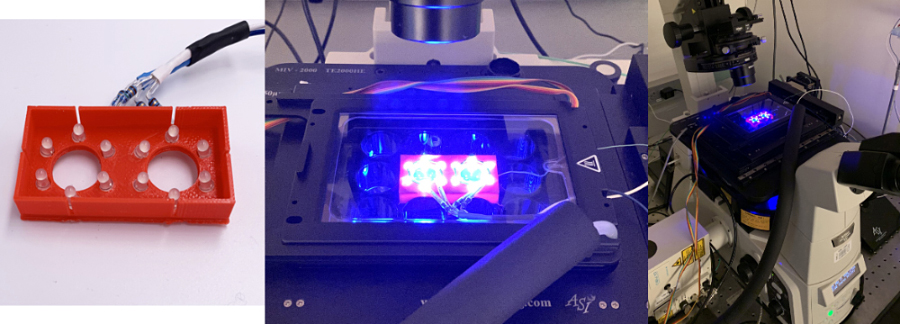 This LEDcube with blue LEDs is suitable for optogenetics experiments with blue light receptor domains, including A.s. Phot1 LOV2, A.t. Cry2, N.c. VIVID (or magnets). The LEDcube was designed to be used for optogenetics experiments in combination with live cell microscopy on an inverted microscope. The LEDcube fits on top of a 12 well plate and illuminates two wells simultaneously (and fits inside a small stage top incubator). Blue light pulse duration and frequency are controlled via an Arduino microcontroller. The LEDcube illuminates 2 whole wells simultaneously, allows for precise temporal control (no spatial control) and is compatible with transmitted light microscopy and high resolution fluorescence microscopy (i.e. confocal, spinning disk confocal, TIRF, SIM, STED). Since the blue light illumination is independent of the objective, one can perform multipoint acquisition experiments, thereby accelerating the throughput of your optogenetics experiments. 3D Printing of the LEDcube Below you can find some files for 3D printing the LEDcube, or for changing the design (FreeCAD) A Freecad 3D model can be downloaded here: LEDcube_FreeCAD-file An STL 3D print file can be downloaded here: LEDcube_STL-file Compatible 12 well plates The LED cube was designed for the following blackwell 12 well glassbottom plates: catalog number P12-1.5H-N , Cellvis. You can find these here: Cellvis-12-well-glass-bottom-plates. Note: 12 well plates from different manufacturers seem to vary quite a bit, i.e. well diameter, well spacing and height, and the LEDcube doesn't fit in all of them. (In the future I might add a list of other 12 well plates that are compatible with the LEDcube) Compatible microscope stage top chambers The LED cube was designed to fit in an Okolab UNO Stage Top Incubator with perfusion holes on the side(for the wires of the LEDcube). A model without perfusion holes exists, but we have not tested if the LEDcube fits in this chamber. |

|